
A gentle tummy massage is one of the simplest ways to help a baby who is struggling with wind, colic, constipation or reflux. Done slowly, in a clockwise direction and at the right time, it can help move trapped air along the gut and settle an unhappy baby. This guide brings together the strokes IAIM Singapore instructors teach parents, which way to rub, how often to massage and the warning signs that mean your baby needs a doctor rather than a massage.
How Tummy Massage Helps Your Baby’s Digestion
Your baby’s digestive system is still maturing in the first few months. Swallowed air from feeding and crying, and slow-moving stools, can cause cramps, straining and long crying spells. Gentle pressure on the abdomen, combined with leg movements, encourages the natural movement of the gut and helps release trapped wind.
Massage also calms. A baby who is held, spoken to and stroked by a parent tends to relax, and a relaxed tummy is easier to soothe than a tense one. Health services such as NI Direct’s guide to infantile colic list gently massaging your baby’s tummy among the techniques that may help a crying baby.
Which Way to Rub Your Baby’s Tummy
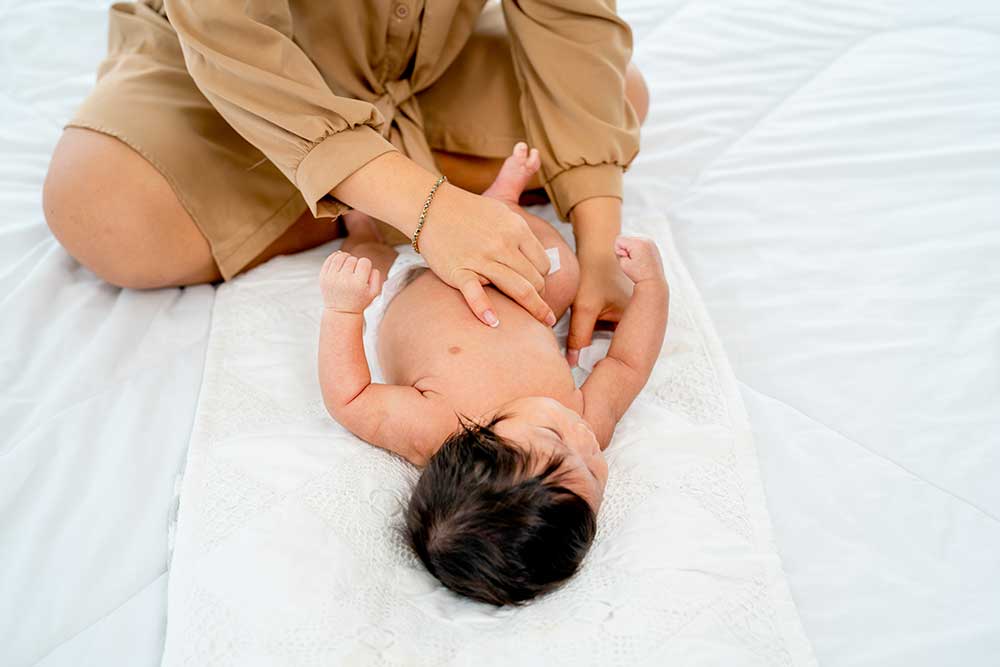
Always stroke your baby’s tummy clockwise, as you look down at your baby. This follows the direction the large intestine moves food and air, from your baby’s right side, up, across and down their left side. Rubbing anti-clockwise works against that natural flow.
- Use the flat of your fingers, not your fingertips.
- Keep the pressure light but firm enough not to tickle.
- Stay below the ribs and above the nappy line, and avoid pressing on the belly button of a newborn whose cord stump has not fully healed.
Five Gentle Strokes IAIM Instructors Teach
1. Ask permission
Before you start, rub a little oil between your palms, show your baby your hands and ask, “May I massage your tummy?” Watch for relaxed limbs, eye contact and coos as a “yes”. This simple ritual is at the heart of IAIM classes, and you can read why in our guide to asking your baby’s permission before massage.
2. Water wheel
Place one hand flat across the top of the tummy, just below the ribs, and stroke down towards the nappy line. Follow with the other hand, like a paddle wheel turning. Repeat six times.
3. Sun and moon
With your left hand, make a full clockwise circle on the tummy (the sun). With your right hand, make a half circle from your baby’s right side over to their left (the moon). Keep the sun circling while the moon follows.
4. “I Love You” stroke
Trace an “I” down your baby’s left side, an upside-down “L” across and down, and an upside-down “U” from their right hip, up, across and down the left. Many parents say these words out loud as they go.
5. Knees up
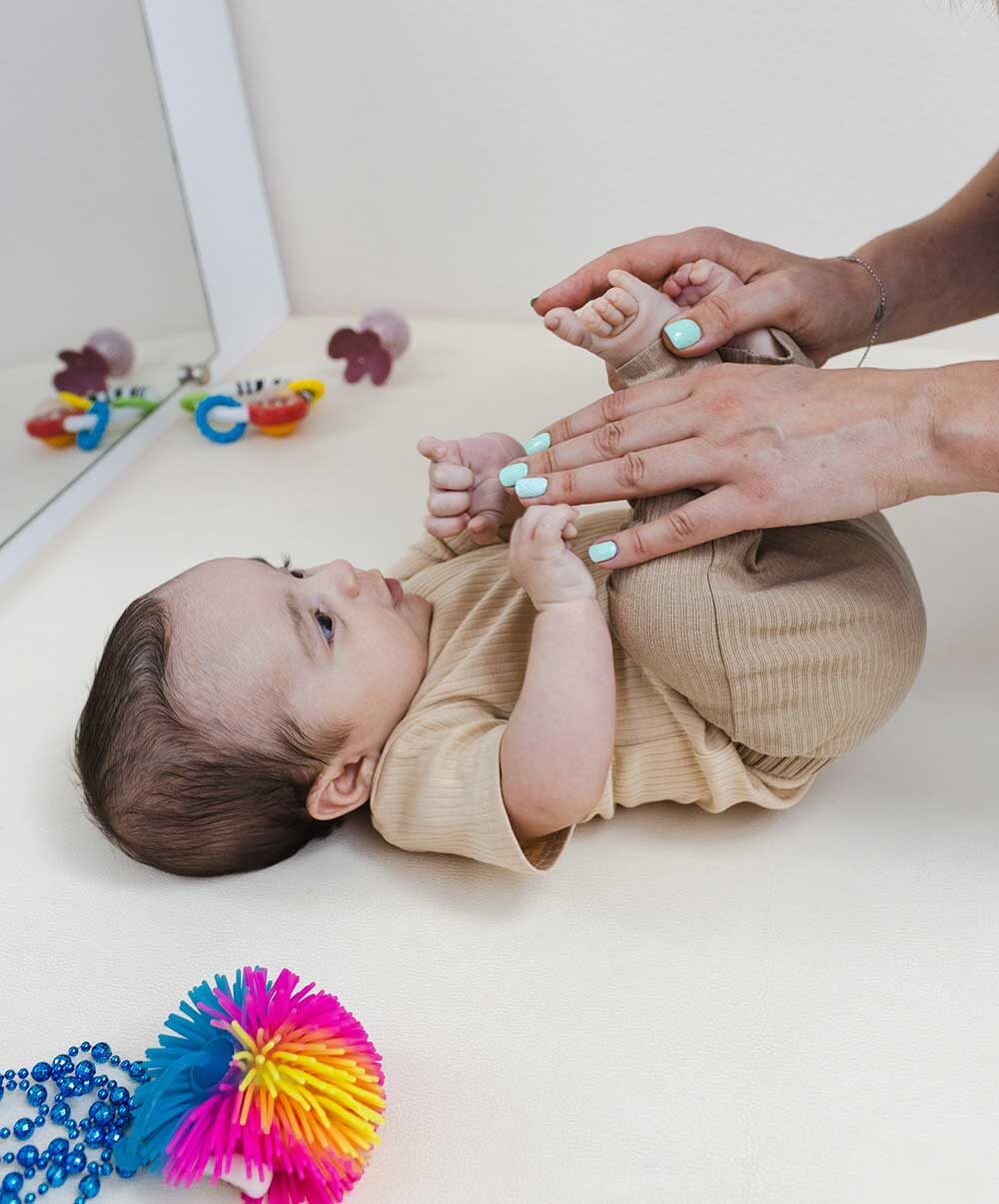
Hold both lower legs, gently bring the knees up towards the tummy and hold for a few seconds, then release and gently stretch the legs out. Bicycle movements, one leg at a time, work well too.
Massage for Common Tummy Troubles
Each tummy problem needs a slightly different approach. Our in-depth guides cover them one by one:
- Constipation: knee bends and the “I Love You” stroke can help a baby who is straining. See baby massage for constipation.
- Gas and trapped wind: water wheel and bicycle legs help release air after feeds. See baby massage for gas.
- Colic: a calm, predictable routine matters as much as the strokes. See baby massage for colic.
- Reflux: timing and position are key, and some strokes should be avoided. See infant massage for reflux.
When and How Often to Massage
Choose a time when your baby is calm and alert, not hungry and not straight after a feed. Waiting 30 to 45 minutes after feeding reduces the chance of bringing milk back up. A few minutes of tummy strokes once or twice a day is enough. If your baby fusses, cries or turns away, stop, cuddle them and try again later. Our newborn massage safety guide explains the cues to watch for.
When to See a Doctor
Massage is a comfort measure, not a treatment for illness. Contact your doctor or polyclinic promptly if your baby:
- has a fever, or is unusually sleepy or floppy
- vomits green or yellow fluid, or vomits forcefully after every feed
- has blood in their poo, or very hard, pellet-like stools
- has a swollen, hard tummy or seems to be in severe pain
- is not feeding well or not gaining weight
Learn the Strokes With a Certified Instructor
Reading about strokes is a good start, but most parents find it much easier once they have practised with guidance. In our 5-week baby massage course in Singapore, a Certified Infant Massage Instructor shows you each tummy stroke on a doll while you massage your own baby, and helps you adapt the routine to your baby’s cues. You can check upcoming sessions and fees on the class schedule, or book a private home visit if a group class does not suit your family.